The Pouladuff Coursing Club was founded on December 12th 1929 by a group of enthusiasts from the general area. Coursing was a sport where owners and their greyhounds would pursue game and other animals across large tracts of land. To this end , they rented ground from local farmers for this purpose. The function of the club was to bring together the greyhound fraternity and regulate the sport for the benefit of all concerned. The club would very soon amalgamate with Bishopstown. The commitee was made up largely of old Republicans and John Joe Hegarty of The Laurels , Pouladuff Road soon joined their ranks upon his return from the U.S. in 1932 later going on to join the committee. In the 1940s his passion for greyhounds extended to the
racing track where he bred two winners , " Urhan Bridge " and " Hi Maeve
". He later helped to found the Cork County Open Coursing club which
brought all the clubs together.
Carroll's Field , Kilmurriheen , Togher
Flapper track used by Pouladuff Coursing Club
Dog shed in old flapper track
Kilmurriheen , Togher
John Joe Hegarty ( 2nd from left ) with family members
The coursing club was heavily regulated and fines and penalties would be handed out to anybody breaking the rules. A list of landowners and fees payable were kept in their Lease Book ( see below ). Jim Hegarty remembers during the 1960s , he and his friends would often find themselves out by the then new airport trapping hares for enclosed coursing at Blarney. They could be heard shouting and beating the ground with sticks and periodically had to stop while passengers entered the terminal. Jim recalls how the passengers must have thought they'd landed in a mad place. Besides the usual venues for open course and racing tracks , there was also a " flapper " track located in Kilmurriheen known officially as Parkwest Track & Kennels but known to locals as Carroll's Field where new puppies could be tried out by their owners. These particular tracks were completely unregulated and had no code of conduct. However they proved very useful for the breeders in selecting future champions. Today the track is unused and overgrown while the concrete sheds which housed the dogs are in a ruinous state.
Gus Fennell ( with Cup ) & Jim Hegarty
holding greyhound 1960s
Obi. John Joe Hegarty 1973
Below is a copy of the original Lease Book of the Pouladuff & Bishopstown Coursing Club from 1940 showing all the Townlands rented out for the sport. The plastic markers glued next to each entry indicate that full payment has been made to each landowner for the use of the land. It can be seen that many of the Townlands were part of the greater Togher territory.
*Coursing is regulated under the Greyhound Industry Act, 1958, chiefly by the Irish Coursing Club (ICC), subject to the general control and direction of Rásaíocht Con Éireann (RCÉ).
Togher Historical Association recently met up with Joan McCarthy to research her family biography on the old Sexton farm off Lehenaghmore Hill. The story takes in the 1940s right up to the 1970s and throws up some surprising pieces of information from an historical perspective. Joan recounts decades of memories covering everything from Emigrants Christmases to farming activities to a very famous opera singer! Hilary O'Donovan , the current owner and her son Adam gave the team a tour of the house and lands and provided artifacts and additional information and brought the story of the farm up to date.
Old Sexton home ( now owned by Hilary O'Donovan )
John Sexton ( Togher ) and his wife Mary Goggin ( originally from Ballinagree , Macroom ) bought the farm inLehenaghmore , Togher in the early 1940s which had been previously owned by Catherine and Cornelius Mulcahy , a married couple who
had no family of their own and who had recently passed. Cornelius' siblings all lived on the land
at the time , each owning a portion of the overall land. The following Census records for the years 1901 , 1911 and 1926 track Cornelius from a young only child/man to a married man who along with his wife , as previously mentioned , both died childless less than two decades later leaving the disposal of their property and land to his surviving family members.
1901 Census Cornelius & his parents David and Hannah ( Hannah originated from Ballymyrtle )
Mulcahy house information 1901 Census Note entry for Mulcahy roof as 0 indicating that it was thatched
1911 Census - Mulcahy
1926 Census - Mulcahy Note : Parents have passed on and he is married Entry lists marriage as being 13.5 years ergo 1912/13 year of marriage
The Sextons would take possession of three large fields extending all the way back to the Liberty Stream and beyond the Cork Bandon railway line which ran through their land. John also had a relative living on Doughcloyne Hill , Maurice Sexton , who was a land steward for the Sarsfields and the Sexton name was well revered by that family for their " honesty , integrity and loyalty ". They would go on to have 3 children Joan b.1944 ,Margaret b.1945 , Maurice b.1946 and were known as the "
Irish Triplets ". Joan explained that if you had 2 babies within a
year they were known as Irish Twins and 3 within 2 years were known as
Irish Triplets. John Kevin was born some time later and would
eventually go on to inherit the farm in 1974 before selling it on in 1985 to Hilary O'Donavan who now operates a kennels in the old stables which was recently renovated. She recalled how her parents were very kind not only to those in need but also to animals which they believed had feelings as well. Joan mentioned that early on in her life , her parents ensured that she
knew the running of the farm in case of any mishaps to either of them.
So it was that there developed 2 distinct nuclei within the family ; Joan's
parents and herself and that of the 3 younger siblings. Joan joked that
she was never really a child.
John & Mary Sexton
During the war , the Irish Government decided that all farmers had to put aside a percentage of their land for the growing of grain as food imports from the U.K. were halted. 10% for small farms , 17½% for medium farms and 25% for large farms. This was essentially used to feed the country. Between 2 to 4 acres of the Sexton land was given over for this purpose. However once the War finished and there was enough food being produced
in the country , the Sexton farm was no longer required to grow grain. Joan remembers the last threshing in that field ; the big machine and the smoke and the smell. Today that land is situated between Joan's sister Margaret's house and the estate to the rear. The question then arose as to what to grow in the field. Mrs. Sexton was the manager of a large grocery retail outlet in the City owned by her cousin. Joan's mother had the bright idea of growing vegetables as there was a shortage in the country at that time of good quality vegetables. Joan described it as a light-bulb moment. All types of cabbages - Winter Cabbage and Spring Cabbage , cauliflower , broccoli , kale and brussels sprouts. There was great demand for their produce and they couldn't grow it fast enough. A stall was kept adjacent to the main house which served as both a cattle shed for milking with the other half for the horses. Their house was originally two storeys but was reduced to a single dwelling when the upper storey began to bulge outwards and was dismantled. In time it would be built up again.
John Kevin , Margaret & Maurice 1955
Joan remembers one memorable occasion when one of her Fathers greyhounds had attacked and killed a mother fox who had just given birth to fox cubs , so the siblings took the cubs in and reared them. This local story drew the attention of a newspaper photographer who traveled out to Togher to capture the scene for posterity ( see photo above ). Unfortunately Joan was ill in bed at the time and so was not featured in the picture.
Drawing commissioned by Hilary O'Donovan
of Sexton farmhouse as it looked when reduced to single storey
Mr. Sexton had cattle on his land and started a milk run. He would go on to become one of the founding members of C.M.P. in 1955. Soon customers started buying vegetables as well. Mrs. Sexton then introduced chickens , turkeys and ducks to the farm resulting in a mixed farming practice. Her farming background meant this was second nature to her so no additional learning was needed. Although they had hundreds of turkeys , the sheer demand at Christmas meant they couldn't meet all the orders. Word of mouth amongst the customers about the quality of the farm produce ensured a thriving business. At the time immediately following the end of the War , there were no supermarkets and grocery stores didn't sell fresh meat or eggs. Carrots , parsnips , potatoes and turnips were also grown on the farm. Joan had her own little patch where she would grow lettuce assisted by her father. The kindness of the Sextons was exemplary. If they knew of a hardship case in the locality they would help ease the burden. Mr. Sexton ran the milk run in the mornings and the meat and vegetable run in the afternoon/evening. He came to know of his customers plights and would deliver produce free of charge. This was done by Mr. Sexton making his customers feel as if they were doing him a favour. So a chicken would be delivered on the premise that they had one extra and it was in danger of going off as back then there was no refrigeration and in most cases no electricity. So it was with vegetables as well. If they could help someone in need they simply did. They also had a piggery on their farm and often the sows would give birth to as many as 15 piglets or Banbh which resulted in the children helping to feed them from little bottles.
Original C.M.P. glass milk bottle found
on the old Sexton farm by current owners
Dinner time in the Sexton household was sacrosanct and was immediately followed by the Rosary and a litany of prayers for somebody dead or unwell etc. Joan recalls her parents always said a prayer for the souls of Catherine and Cornelius Mulcahy , the previous owners of the land. This would also include anybody who ever lived on the farm. This was a mark of respect for the people who lived on the land and the land itself. Joan recounted how an elderly Aunt came to stay who was nearing the end of her life. Shortly after she faded away and died. That night a Doctor and a Curate Priest from the Lough Parish arrived and stayed the night. The children and everybody present knelt around her bed and prayed. Joan recalls the Curate Priest saying how he never thought he'd be back in this room again and how he had slept in that very room! It transpired that he was a nephew of Catherine and Cornelius and while training in Farrenferris he would stay at the house. He was of course Fr. Mulcahy. His emotions were evident as the tears rolled down his face when he learned of the practice of praying for those who had once lived there as if they were somehow still there. Although a curate at the time he would return years later as Parish Priest of The Lough.
OSi map showing Sexton farmland off Lehenaghmore Hill
with Cork Bandon line running through ( from Deeds supplied by Hilary O'Donovan )
All the children of the household attended Togher National School ( now Community Centre ). It was a 2 Teacher school back then for the girls. Ms. McCarthy was the Principal and Ms. McSweeny her assistant. Joan described them as lovely people and she enjoyed her time there. Joan mentioned that such was the quality of the education she received at Togher National School that when she went to Secondary School , she could have easily sat the Intermediate Certificate ( now Junior Cert ). There was even a 7th class at Togher for those who knew they wouldn't be moving onto Secondary School. This served the purpose of compacting a de facto Secondary education into a full year to prepare the pupils for life and work. Joan was at pains to point out how blessed she was for the parents she had , the people she grew up with , the Teachers she had and the area she grew up in describing it all as wonderful and magical.
Plot owned by Hilary O'Donovan 1985 - present ( from Deeds supplied by Hilary O'Donovan )
Many young girls would emigrate to both England and America after the War and work in the houses of wealthy people. A practice developed whereupon any clothes that their Employers children had outgrown would be rescued from the garbage and sent back home to their respective families to serve as material for making coats and trousers and dresses as fabric was either in short supply or couldn't be afforded. This coupled with also sending money back home helped to keep families afloat in hard times. The Sextons would be considered well off owning a farm but were by definition asset rich and cash poor. Irish people home on holidays would leave clothes behind when they left again and mothers all over the community would recycle them by unpicking the seams and turning them inside out as the material on the inside would not be faded and conjure up 2 coats for their children to wear until they outgrew them. Self sufficiency and recycling were the mothers of necessity long before it became fashionable. So too was the case for young adults who would wear the clothes donated them by visiting relatives , many of the clothes being from the 1940s and now still being worn in the 1960s. Joan recalls that after the end of the War , the scarcity of everyday items was very much to the fore. This included paper. Even a child's bow was a luxury. A simple pencil would be highly prized. Everything had value and nothing was thrown away.
Remains of old pitchfork found on land
Joan recalls how her cousins on Doughcloyne Hill , Joan and Maurice Sexton who never married , bought the house off the S.M.A. She explained that much confusion ensued over the practice of naming children after mothers , fathers , grandparents etc , so much so , that there would be a proliferation of same name boys and girls in various branches of a family. She gave one example of a boy in Macroom who was known as Pat John Jack. Pat being his given name , John being his father's name and Jack being his grandfather's name. So by using this triplet of names he could be easily identified! The same practice migrated to Togher as many West Cork people settled there over the years.
Daly Brewers whiskey bottle found on land
( they also invented Tanora! )
Every summer in Lehenaghmore and indeed across most of the townlands of Togher and the City , there was an annual event known as the Emigrant's Christmas. To facilitate this , a pre-ordered turkey would be kept on by local farmers including the Sextons until the warm weather approached for sale to the locals who would be celebrating such an event. This tradition came about through the practice in America of Irish families saving hard to send one member of the family home to visit relatives. The big get together would be held more often than not near the Lough and a festive spread laid on on a table. Various relatives would bring Christmas pudding , cake and other luxuries to add to the feast. Occasionally , Mr. Sexton would let out one of his fields and provide transport with his horse and cart to ferry family members to and fro. Here the Emigrant's Christmas either consisted of newspapers on the ground on which to lay out the food or a table with newspapers as people could easily dispose them. So it was that various members of families living abroad would make the journey home about once every five years or so to visit aging parents or younger brothers , sisters or cousins or aunts etc. Joan recounts her parents mantra " Thanks be to God we have enough , and those who haven't we must mind. "
Old pocketwatch case and shaving implements found in house
When Mr. Sexton passed away , Joan recalls a group of men who approached her and asked was she called Joan. When she confirmed , they told her that they remembered her as a child when she accompanied her father on his runs and that her father had kept them alive during hard times when they were children through his generosity in supplying free food. This backed up other stories Joan was told when in secondary school by classmates who told of similar tales of kindness by her parents. She describes her entire childhood as a fairytale where every day something new would happen , whether it was the first buttercup , bluebell or blossom on the apple trees or the birth of a foal or a calf. They never played out on the road as there was always something magical to see and do on the farm.
Bandon to Cork train passing through Sexton farmland circa 1950s
Joan was an avid choir singer and besides singing in the school choir at Togher also participated in a youth and adult choir in Togher and the City in which they would represent Ireland in International contests. She also adored opera music and on one memorable occasion was mesmerized by one particular singer at the city hall. She mentions that they would often join them for after show refreshments in which the visiting Italians would have wine served to their table while she and her fellow choir members would have water or cordial to share amongst themselves. They then brought the visitors around the City for a tour of the old and new buildings. The singer who so impressed Joan back in 1963 was none other than Luciano Pavarotti! It is known that locals would take in visiting male voice choir members as lodgers during their stay in Cork. So some family unwittingly had a future Opera star in their home! Pavarotti later famously recalled his time in Cork as full of beautiful girls and hills!
Pavarotti in male voice choir City Hall
Pavarotti as he looked in 1963
Joan recalls as they grew older they would often travel to dancehalls around Cork as a group with other local boys and girls. The bus would drop them off in the Grand Parade after midnight and they would walk home from there. The street lights only went as far as the Lough and from thereon it was pitch black. The girls would be escorted each by one local boy right to their doorstep without even a goodnight kiss. This was how things were done back then when everybody looked out for each other.
Renovated stables now used as a kennels
Joan eventually left Togher after she married in 1970 but still frequently visits her old home , now in the ownership of Hilary O'Donovan who has lived there since 1985. Joan's sister Margaret lives in a house on the old lane leading up to what used to be their home. She also made mention of the local topography of the land being changed beyond all recognition when the nearby housing schemes were constructed. Much of the top soil was bulldozed to such an extent to level off the land that it formed a steep gradient just beyond their old home down to the stream. Previously the land there was not as high or hilly. But the land thereabouts still echoes to the laughter and memories of a bygone age.
*********************
Hilary with sons Alex and Adam
In tandem with Joan McCarthys biography of her old home the team visited the current owner Hilary O'Donovan who welcomed them into her home and presented her deeds for analysis ( see earlier ). Adam Duggan gave a walking tour of the nearby lands which included the remains of a lodge near the Liberty Stream and remnants of the Osiery in the marshy ground where flax willow would have been cultivated to make baskets and other household items in lieu of future plastic. This would have been the primary purpose of the land under the Mulcahy owners stretching back to the 19th Century in addition to other agricultural uses.
19th Century map showing Osiery next to house
Pathway leading off old Sexton house to stream and Coventry House
Ivy covered remnants of old lodge house near Liberty Stream
Wild growing willow flax near marshy ground
It should be noted that an old pathway lead off the Sextons courtyard down to the lodge near the Liberty Stream ( which acts as the boundary between Lehenaghmore and Doughcloyne ) and up to the now long gone Coventry House ( only partial orchard walls remain ). This has since been more or less covered in. Adam Duggan also showed the exact location of one of two Fulacht Fia just across from the Liberty Stream. A hollow in the field which is barely visible , this would date back well over a thousand years and links to ancient human habitation on the lands. These water filled pits would have had hot rocks thrown into them to heat the water , which had many uses such as bathing , beer brewing and dyeing of cloth. The team were also shown many artifacts found in the house and on the land over the years. Following a renovation of the kennels , it has been renamed The Osiery as a legacy to the lands past.
Old orchard walls of Coventry House on brow of hill
Fulacht Fia near Liberty Stream
Interior of Kennels
Coins dating back to 1890s found inside old walls of former stables
Liberty Stream on Sexton land
Liberty Stream near old railway line
*** Many thanks to Craig McCarthy for arranging the meeting with his mother Joan McCarthy and to Hilary Donovan and family for providing additional information and photographs. ***
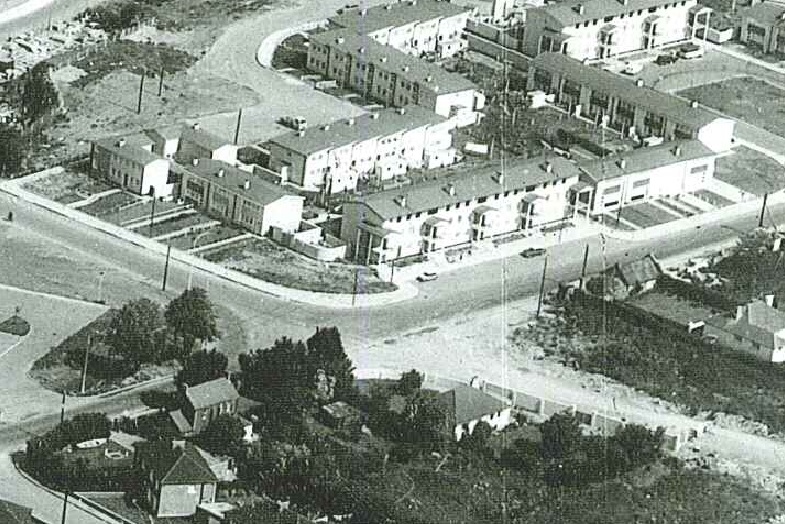
Demolished at the dawn of the 1970s , a small nucleus of workmen's houses known locally as Ardmanning Cottages brought to an end many years of local and social history in Togher. Nestled in between Long's Farm and Carmelville , they were situated on the south eastern side of Togher Road. Today all that remains is a grassy verge fronting onto the main road , which stretches from the entrance of Rose Lawn ( constructed 1965 ) to the corner of Vicar's Road ( constructed 1971/2 ).
Cottages prior to demolition 1969
Poor quality photo showing alternate view of cottages 1971
Cottages ( centre of photo ) 1971
Cottages ( in process of demolition ) 1971 Rear view ( Centre Right )
Aerial view of Ardmanning Cottages 1951
Residents
The houses which were constructed in the 19th Century as labourers cottages were home to 5 families , which are as follows:
Number 1:
Crowley's & Buckley's
Originally the home of the Crowley's. This later was home to brother and sister Leo and Birdie Buckley. Birdie Buckley moved out in the 1940s to the timber house on the corner of Hangdog Road next to
the railway bridge. She married an O'Sullivan who died shortly after
and she always wore black thereafter. Leo eventually married and had 3 children - John , Mary and Noreen. ( Mary O'Connell : I lived on Edward Walsh Rd and played with Mary Buckley and I think her older brother John. " )
Leo and the family moved to a new house in Killreendowney Ave. Ballyphehane when the cottages were demolished circa 1969/71. John , his son moved to Palmbury Orchard where he still resides. Noreen moved to Ballyphehane as well and still lives there.
Dolores Murphy - Edward Walsh Road : " I moved to Togher in 1964 when I was 7. So maybe I was about 11 when the Buckley's left. So I think late 1960's. There were 2 rooms in the cottage. A single bedroom and the kitchen for all of them. "
Jim O'Sullivan - Rose Lawn - " I
remember these houses ; the first one was lived in by the Buckley family. I
remember playing there as a kid , sons name was John who would have been a
few years older than me. We were living in the countryside back then and across the road
was a huge dairy farm. "
Number 2: Ellis
Tom Ellis : " We
lived in the second cottage and had a market garden above Buckley’s. My
grandpa used to grow all sorts of vegetables for the market in grand
parade.Past the cottages was Pata Cronin and Bunny's bungalow. There was an old water pump outside which was our water supply as there was no water in any of the cottages. "
Number 3: Foley
Dunnie Foley: " My grandfather was a market gardener in the field behind the house.I remember my Nan putting his dinner on his backdoor step. My Nan's name was May Foley. " It is reputed that the cottage never had any electricity.
Number 4 : Sullivans , Barrett's & Campbells
Originally the home of the Sullivan's and then the Barrett's before finally becoming for a short time the home of the Campbells.
Elizabeth Murphy Sheehan : My late aunt and uncle Nancy and Donie Campbell lived there for a short time after their marriage in 1966.
Number 5 : Reardons
*No information at present*
Grass verge - original location of Ardmanning Cottages
Togher Historical Association was honoured by an invitation to the official opening of the Garden of Remembrance and Reflection at Clashduv Park on Saturday 8th April 2pm. Also in attendance were Togher Tidy Towns under the leadership of Fergal O'Connor and members of the combined Togher Ballyphehane Centenary Committee. M.C. for the day was Keiran O'Connell ably assisted by Ciara O'Mahoney. A huge turnout of members of the Hegarty , Forde and Fennell families and friends and locals made it such a memorable day.
M.C. Keiran O'Connell with flag bearer
Dean Nigel Dunne C of I delivering the blessing
Lady Mayoress Deirdre Forde opening address
Planting of the trees of Liberty and Equality
Dean Nigel Dunne of the Church of Ireland gave the opening blessing followed by the Lady Mayoress Cllr. Deirdre Forde giving her speech acknowledging the women of Ireland. Ciara O'Mahoney secretary of the Ballyphehane Togher Centenary Committee also thanked the Togher Historical Association for their suggestion on dedicating the Garden to the Hegarty sisters including their brother John Joe. Fergal O'Connor of Togher Tidy Towns gave an oration followed by Jim Hegarty who delivered the key speech in honour of his Aunts Nan and Mamie. It was fitting that his father John Joe was also mentioned on the inscription of the placue.
Ciara O'Mahoney
Togher Ballyphehane centenary committee
Fergal O'Connor Togher Tidy Towns
Jim Hegarty keynote speech
Adam Duggan , a relative of the Hegartys played a lament while a choir sang " Grace ". Also involved were Ballyphehane pipe band who played magnificently. The highlight of the event was Mamies grandson playing his rendition of Paul Murphy's song , " The Hegartys of the Laurels ". A tree planting ceremony was conducted by the Lady Mayoress who honoured Nan and Mamie by naming the trees Liberty and Equality. A fantastic day which will live on in the memories of all who attended.
Adam Duggan , Lehenaghmore , Togher
playing a lament
Billy O'Brien - Togher Historical Association
with Shirley Kelleher - Joe Murphy's grandniece
Billy O'Brien & Kathleen O'Keeffe
Togher Historical Association
with Lady Mayoress Deirdre Forde
Togher Historical Association
with Lady Mayoress , Jim Hegarty & Shirley Kelleher
Mamie's grandson singing " The Hegartys of the Laurels "